| Finding/test | What it can mean | Main limitation |
| Circular alopecia and scale | Compatible with ringworm | Many skin diseases look similar |
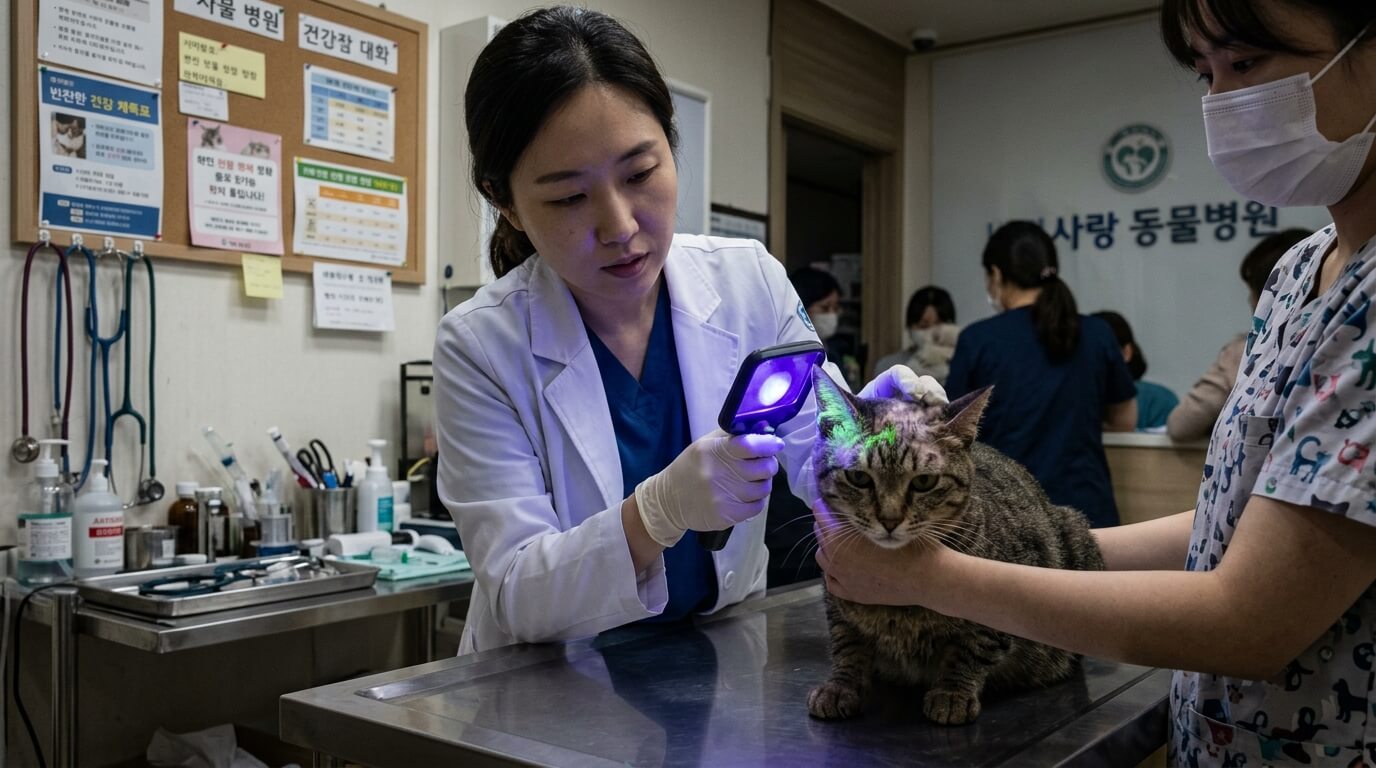
| Wood’s lamp fluorescence | Can help find M. canis-infected hairs | False positives and negatives occur |
| Direct microscopy | Can identify infected hairs | Sampling and experience matter |
| Culture/PCR | Useful confirmatory tools | Interpret with the clinical picture |
| Environmental cleaning | Reduces infectious hair/spores | Consistent cleaning beats panic |
A bald, scaly ear tip is not automatically ringworm.
But because feline dermatophytosis can spread to other animals and people, ignoring a suspicious lesion for weeks is not ideal either.
Kittens, cats from group environments, and cats living in multi-cat homes may deserve a particularly thoughtful work-up.
🔎 Ansim-i explains: dermatophytosis is not diagnosed by lesion shape alone, and a Wood’s lamp is a screening tool rather than a final answer.
Do ear-tip hair loss and scale tell you that a cat has ringworm?
Dermatophytosis can cause circular or irregular alopecia, broken hairs, scale, crust, and mild redness. Lesions are often noticed around the face, ears, and limbs.
But mites, allergy, bacterial skin disease, trauma, and self-induced hair loss can produce similar appearances.
Some infected cats have very subtle lesions or can carry infectious material without the classic “ring” that owners expect.

Does green fluorescence under a Wood’s lamp confirm ringworm?
A Wood’s lamp emits ultraviolet light that can make some Microsporum canis-infected hairs fluoresce a characteristic color.
Used correctly, it is excellent for finding subtle lesions and selecting hairs for additional testing. However, debris, scale, and topical products may fluoresce, while some dermatophytes do not.
So “glows = confirmed” and “doesn’t glow = ruled out” are both oversimplifications.

What tests can confirm feline dermatophytosis?
Veterinarians may combine Wood’s lamp examination, direct microscopic examination of hairs and scales, fungal culture, and sometimes PCR.
Wood’s lamp-positive hairs can be especially useful targets for direct examination. Culture helps demonstrate viable dermatophytes and can support monitoring in selected cases.
The best combination depends on lesion stage, prior treatment, household setting, and test availability.
Can feline ringworm spread to people?
Dermatophyte spores can spread through direct contact with infected hair or indirectly through grooming tools, bedding, and contaminated shed hair.
Basic hygiene matters: handwashing, separating grooming tools, laundering washable bedding, and cleaning the areas where the cat spends time.
If a person—especially someone immunocompromised—develops a suspicious skin lesion, tell the healthcare provider about possible feline dermatophyte exposure.
Environmental cleaning: do you need to disinfect the entire house?
The goal is not to make a home sterile. The most practical step is repeated removal of infected hairs and dust through vacuuming or appropriate surface cleaning.
Washable bedding and fabrics should be laundered regularly, while high-contact surfaces are cleaned with a product appropriate for the household and used according to label instructions.
Medication and environmental cleaning work together; dramatic one-time cleaning is less useful than consistent management.

Why ringworm treatment often takes weeks
Dermatophytes grow in keratinized tissues such as hair and superficial skin, so recovery depends on clearing infection while healthy hair replaces infected hair.
Depending on severity and household risk, topical treatment may be combined with systemic antifungal therapy. Drug choice and duration require veterinary oversight.
Visible hair regrowth does not always mean all infectious material is gone, so treatment end points are based on re-evaluation rather than appearance alone.
What to do in a multi-cat household
Check housemates for subtle alopecia, scale, broken hairs, or crusts and avoid sharing brushes during the diagnostic period.
Do not automatically medicate every cat with the same drug. Exposure risk, examination, and diagnostic findings guide the plan.
Isolation can create substantial feline stress, so physical separation should be practical and balanced with welfare while cleaning and treatment continue.
Ansim-i’s Research Note: the Wood’s lamp is a detective flashlight
A Wood’s lamp is fast, inexpensive, and genuinely useful—but it is not the judge and jury.
Its greatest value is helping clinicians find suspicious hairs and choose better samples for follow-up testing.
Owners can help by bringing dated photos, noting when lesions began, and mentioning similar skin changes in other pets or people.
🔬 Veterinary Evidence & References
Magentalab Research Team has reviewed relevant veterinary guidelines to verify the core content.
💡 Key Medical Evidence Summary
Wood’s lamp examination is a useful point-of-care tool for M. canis, but false-positive and false-negative results occur. Consensus-style dermatology guidance supports combining clinical examination with direct microscopy, culture and/or other tests as appropriate.
Dermatophytosis in Cats
•
Guideline
Feline dermatophytosis: Clinical features and diagnostic testing
•
Guideline
⚠️ Medical Disclaimer & Individual Variance
Do not start or stop systemic antifungals without veterinary direction. If a person in the household develops a suspicious skin lesion, tell the healthcare professional about possible feline dermatophyte exposure.
Veterinary Clinical Guidelines & Institution Guidelines
* Evidence classification based on Magentalab evaluation standards.
Leave a Reply