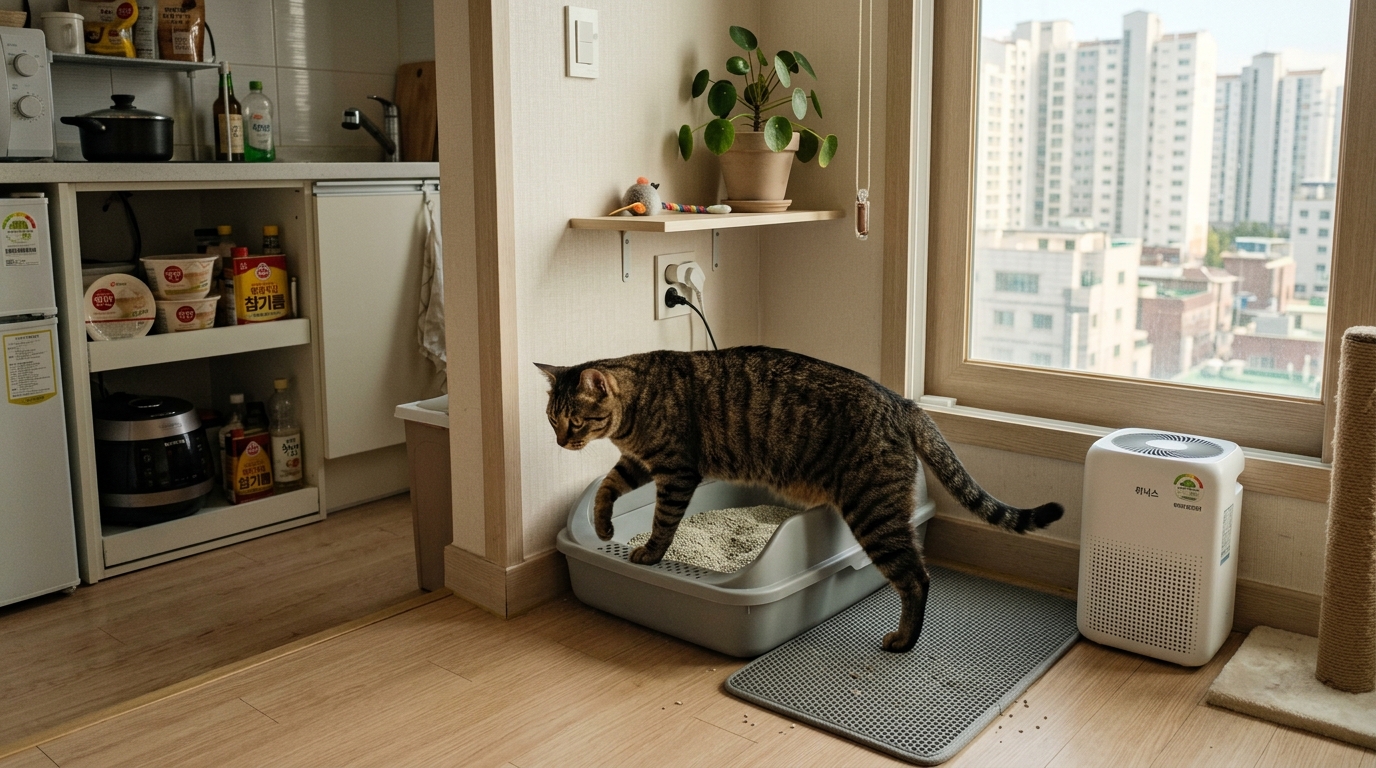
[안심이 요약 (new_ansim_summary)]
- If your cat suddenly urinates on the bed, laundry, carpet, or floor, do not assume it is spite or stress; medical problems affecting urination, mobility, or urine volume should be considered first.
- Once urgent medical causes are ruled out, look at posture, location, and urine amount to distinguish ordinary urination from urine marking, then evaluate litter box size, location, cleanliness, accessibility, and your cat’s individual substrate preferences.
- If your cat repeatedly enters the litter box, strains, and produces little or no urine, especially if the cat is male, stop treating it as a behavior problem and seek urgent veterinary care for possible urethral obstruction.
F형 공감:
Waking up to a wet blanket can be exhausting, and it is understandable to wonder, “Why my bed?” But Ansim would rather have you ask a different question first: “Has something changed that is making normal litter box use difficult for my cat?”
[검증된 근거 (Evidence)]
핵심 인사이트 (keyInsight):
Urination outside the litter box is not a single disease and cannot be explained by one behavioral mechanism. Veterinary behavior guidance recommends ruling out medical causes first because any condition that changes urine volume, frequency, urgency, continence, pain, or the cat’s ability to reach and enter the litter box may contribute to house soiling. After medical causes are assessed, the evaluation can include whether the behavior is ordinary urination or urine marking, whether the cat avoids a particular box or substrate, whether a preferred surface or location has developed, and whether social or environmental conflict affects access.
Lower urinary tract disease can cause frequent urination, straining, blood in the urine, painful urination, and periuria. Possible causes include feline idiopathic cystitis (FIC), urinary stones, urethral plugs, infection, and other disorders. FIC should not be reduced to a single explanation such as “stress damages the bladder GAG layer.” Current understanding is multifactorial. In addition, osteoarthritis or impaired mobility and diseases that increase urine production, such as chronic kidney disease, diabetes mellitus, or hyperthyroidism, can also contribute to litter box problems.
주의 사항 (cautionNote):
Do not punish a cat for urinating outside the litter box, and do not assume the litter itself is the problem before checking for illness. If your cat repeatedly strains to urinate but produces little or no urine, especially if the cat is male, urethral obstruction must be considered immediately. Do not press on the abdomen to assess the bladder at home, and do not give leftover antibiotics or human medications.
참고 자료 1 (references)
제목: Behavior Problems of Cats
기관/출처: Merck Veterinary Manual
타입: Veterinary Behavior Reference
URL: https://www.merckvetmanual.com/behavior/behavior-of-cats/behavior-problems-of-cats
참고 자료 2 (references)
제목: Feline Behavior Problems: House Soiling
기관/출처: Cornell Feline Health Center
타입: Feline Behavior Reference
URL: https://www.vet.cornell.edu/departments-centers-and-institutes/cornell-feline-health-center/health-information/feline-health-topics/feline-behavior-problems-house-soiling
참고 자료 3 (references)
제목: Feline Lower Urinary Tract Disease
기관/출처: Cornell Feline Health Center
타입: Feline Urinary Health Reference
URL: https://www.vet.cornell.edu/departments-centers-and-institutes/cornell-feline-health-center/health-information/feline-health-topics/feline-lower-urinary-tract-disease
참고 자료 4 (references)
제목: Lower Urinary Tract Disease in Cats
기관/출처: Merck Veterinary Manual
타입: Veterinary Internal Medicine Reference
URL: https://www.merckvetmanual.com/urinary-system/noninfectious-diseases-of-the-urinary-system-in-small-animals/lower-urinary-tract-disease-in-cats
참고 자료 5 (references)
제목: The Special Needs of the Senior Cat
기관/출처: Cornell Feline Health Center
타입: Senior Feline Health Reference
URL: https://www.vet.cornell.edu/departments-centers-and-institutes/cornell-feline-health-center/health-information/feline-health-topics/special-needs-senior-cat
[본문 내용 (Content)]
You wake up and notice that one side of the bed is wet.
At first, you think something spilled.
Then you smell it.
Cat urine.
Your cat used the litter box normally yesterday. But a few days ago, there was urine in the laundry basket, and now it is on the bed.
That is when the questions begin.
“Does my cat hate the new litter?”
“Is this stress?”
“Is my cat angry with me?”
“Why the bed?”
Ansim wants to start with one important point:
Urinating outside the litter box is not one behavior with one cause.
A cat may urinate outside the box because the bladder or urethra hurts. Another cat may be producing more urine than usual because of an underlying disease. A senior cat may find it painful to climb over a high litter box entrance.
In a multicat home, another cat may block access to the box.
The box may be too small, too dirty, too noisy, or placed in a location that feels unsafe.
The litter itself may be disliked.
Or the behavior may not be ordinary urination at all — it may be urine marking.
That is why it is risky to decide immediately:
“It is cystitis.”
“It is the litter.”
“It is stress.”
A better order is:
medical causes first → urination versus marking → litter box access and preference → broader environment.
| What you notice | What to consider first | What to check |
|---|---|---|
| Cat suddenly urinates on bedding, carpet, or laundry | Medical urination problem or litter box avoidance | Frequency, blood, pain, water intake, mobility |
| Cat repeatedly enters the box, strains, and produces only drops | Lower urinary tract disease or obstruction | Especially urgent in male cats |
| Cat stands with tail raised and sprays a vertical surface | Urine marking | Social conflict, new animals, environmental changes |
| Cat squats and empties the bladder on a bed or carpet | Ordinary urination outside the box | Medical causes, box avoidance, substrate or location preference |
| Litter box use drops after a litter change | Litter or substrate preference may be involved | Offer the previous litter as an option |
| Senior cat hesitates at the litter box entrance | Pain or mobility limitation | Entry height, route to the box, veterinary evaluation |
| Cat drinks more and produces larger urine spots | Disease causing increased urine production | Kidney disease, diabetes, hyperthyroidism |
When a Cat Pees Outside the Litter Box, Do Not Start With “Behavior Problem”
Urine on a bed feels personal.
That is part of why litter box problems are so frustrating.
The cat chooses the bed you sleep in, the pile of clean laundry, the couch, or another place that matters to you.
It can look deliberate.
But cats are not usually choosing these places as revenge.
Veterinary behavior guidance recommends ruling out medical causes first because diseases can make urination painful, more urgent, more frequent, harder to control, or physically difficult to perform inside the normal litter box.
So if a cat who has used the litter box reliably for years suddenly urinates on your bed, the first question should not be:
“Did I change the litter?”
It should be:
“Has urination itself changed?”
These Signs Mean Veterinary Evaluation Comes Before a Litter Experiment
A checklist is useful here because these signs need to be noticed quickly.
- Your cat is visiting the litter box much more often than usual.
- Your cat stays in position and strains.
- Urine clumps are much smaller than normal.
- Only a few drops are appearing.
- Your cat keeps straining but little or no urine is visible.
- Blood is visible in the urine.
- Your cat cries or appears uncomfortable while urinating.
- Your cat repeatedly licks the genital area.
- Appetite drops, vomiting begins, or your cat becomes weak or lethargic.
If your cat repeatedly tries to urinate but produces little or no urine, this is no longer mainly a house-soiling question.
Urethral obstruction must be considered.
Male cats are at higher risk because of their urinary anatomy, so they need particularly prompt evaluation.
Do not use a fixed number of hours as permission to wait.
Repeated straining with little or no urine is already a warning sign.
My Cat Peed a Large Amount on the Bed. Does That Rule Out an Obstruction?
A large urination tells you that urine was passing at that moment.
But it does not rule out other lower urinary tract disease.
A cat with bladder pain or urinary urgency may empty a substantial amount of urine outside the litter box.
And the pattern can change.
A cat may produce a large puddle in the morning and later begin making repeated, unproductive trips to the litter box.
That is why one urine spot does not tell the whole story.
Watch what happens next.
Is your cat still producing normal urine?
Are they straining?
Is there blood?
Are litter box visits becoming more frequent?
Periuria Can Occur With FIC, but Periuria Does Not Mean FIC
Veterinary sources sometimes use the term periuria for urination outside the litter box.
Feline idiopathic cystitis, or FIC, can certainly cause periuria.
But that does not make periuria specific to FIC.
Cats with FIC may also show frequent urination, straining, painful urination, and blood in the urine.
Similar signs can occur with urinary stones, urethral plugs, infection, and other lower urinary tract diseases.
So:
urinating on the bed ≠ FIC.
Veterinarians may use physical examination and urinalysis, and depending on the case may also recommend bloodwork, X-rays, ultrasound, or urine culture.
FIC Is More Complicated Than “Stress Damages the GAG Layer”
The bladder has several mechanisms that help protect its tissues from urine.
Changes involving the bladder lining and permeability have been studied in cats with FIC.
But modern understanding of FIC is not:
“Stress → GAG layer breaks down → acidic urine burns the bladder.”
That is too simple.
The exact cause of FIC remains incompletely understood.
Current models involve interactions among the lower urinary tract, stress response systems, nervous and neuroendocrine regulation, and the cat’s environment.
So if your cat urinates on the bed, you cannot conclude at home:
“The bladder lining must be damaged.”
And if there has been no obvious stressful event, that does not rule FIC out either.
It is a diagnosis veterinarians reach after considering and excluding other causes.

Peeing on Soft Bedding Does Not Automatically Mean “The Soft Surface Hurts Less”
A common explanation is:
“My cat’s bladder hurts, so they choose soft bedding because it feels less painful.”
That may sound logical.
Pain can contribute to litter box avoidance, and a cat can form a negative association with a box used during painful episodes.
But we should not assume that every cat deliberately chooses a soft surface because it reduces pain.
In behavior medicine, it is often more useful to think in terms of substrate preference and location preference.
One cat may repeatedly choose soft surfaces such as blankets, clothes, or carpet.
Another may choose a bathtub or hard floor.
Some cats may prefer a particular room regardless of surface.
So rather than assuming:
“Soft bedding means bladder pain,”
look for the pattern.
If Your Cat Always Chooses Bedding, Consider a Surface Preference
Once medical causes have been evaluated, repeated use of similar surfaces can be informative.
If your cat consistently urinates on blankets, laundry, rugs, and carpet, the shared feature may be texture.
If your cat urinates in the same bedroom corner whether the floor is carpeted or covered with a towel, the location itself may matter more.
That is why it helps to record not only:
“Where did my cat pee?”
but also:
“What kind of surface was it?”
Urine Marking and Ordinary Urination Are Not the Same Behavior
This distinction matters.
Not every urine spot outside the litter box is spraying.
Typical urine marking often involves a cat standing upright with the tail raised, sometimes quivering, while directing a relatively small amount of urine toward a vertical surface such as a wall, door, or furniture.
Ordinary urination more often involves a squatting posture on a horizontal surface, with a larger amount of urine released.
Real cats do not always follow a textbook perfectly, so posture alone cannot diagnose the behavior with absolute certainty.
But it is an important clue.
A Large Puddle on the Bed Is Usually a Different Pattern From Wall Spraying
If you saw your cat squat on the bed and leave a substantial wet area, that looks different from classic vertical urine marking.
In that situation, medical disease, litter box avoidance, substrate preference, location preference, or access problems become more likely considerations.
If your cat stands near a doorway with the tail elevated and directs a small amount of urine toward the wall, marking becomes more likely.
Urine marking is not limited to intact male cats.
Neutered males and females can mark too, especially when there are changes in the environment or tension involving other cats.
Even If It Looks Like Marking, Do Not Ignore Health Changes
It is easy to say:
“The cat sprayed, so this is behavioral.”
But a new urinary behavior still deserves attention to the cat’s general health.
This is especially important in older cats.
Chronic kidney disease, diabetes mellitus, and hyperthyroidism can increase thirst and urine production.
A cat may then use the litter box differently, and medical and behavioral problems can exist at the same time.
One cat can have more than one cause.

Litter Texture Can Matter, but Do Not Claim One Material “Hurts the Paw Nerves”
Once urgent medical problems and marking have been considered, it makes sense to examine the litter box itself.
Cats can have preferences for litter texture, odor, depth, cleanliness, and digging quality.
A cat may dig comfortably in one substrate but barely step into another after a litter change.
That is useful information.
But it is too strong to say:
“Tofu litter or coarse litter stimulates the nerves in the paw pads and causes pain.”
Not every cat responds the same way.
The important question is not which material is supposedly universally painful.
It is:
What does this particular cat prefer or avoid?
There Is No Universal “Under 1 mm Bentonite Is Best” Rule
Research and clinical experience suggest that many cats may prefer fine, unscented substrates.
But that does not mean every cat must use one specific particle size or one specific material.
A cat who has comfortably used another litter type for years may have no reason to change.
If house soiling started immediately after a litter switch, however, it can be reasonable to offer the previous litter again as an option.
The key is choice rather than forcing one supposed “perfect” litter.
If You Want to Compare Litter Preferences, Do Not Change Every Box at Once
After medical causes have been addressed, a side-by-side choice can sometimes help identify substrate preference.
Instead of replacing every litter box with the new product, keep at least one familiar option available.
If possible, use boxes of similar size and shape with different litter choices and observe which one your cat consistently uses.
Avoid treating a rigid three-day test as definitive.
A cat may enter a box once out of curiosity.
What matters more is the pattern over time.
The Litter Box Itself May Be the Problem, Not the Litter
It is easy to focus only on substrate.
But the box may be too small.
A large cat may struggle to turn around comfortably.
A covered box may trap odor.
A high entry may be difficult for a senior cat.
The location may be noisy.
The route may be blocked by another animal.
So a useful litter box assessment includes:
litter + box design + location + accessibility.
If a Senior Cat Pees Beside the Box, Think About Mobility
A senior cat who once stepped easily into a high-sided box may begin hesitating.
Maybe jumping has also decreased.
Maybe stairs are slower.
Then one day, urine appears directly beside the litter box.
Do not automatically assume:
“My cat forgot how to use the box.”
Painful joints or other mobility problems may make entry difficult.
Senior cats can also develop medical conditions that increase urine production, which can further complicate litter box use.
A lower-entry box can help some cats, but a new change in mobility deserves veterinary evaluation as well.

Litter Box Location Can Be Just as Important as Litter Type
A perfect litter in the wrong place may still fail.
A box may sit beside a washing machine that suddenly starts spinning.
In a multicat household, another cat may guard the hallway leading to it.
The box may be in a busy area with constant foot traffic.
Or the cat may feel trapped because there is only one way in and out.
So when evaluating location, do not only ask whether the place seems quiet to you.
Ask:
Can my cat enter, eliminate, and leave without feeling threatened or physically challenged?
“One Box per Cat Plus One” Is a Useful Starting Point, Not a Mathematical Law
The common recommendation of one litter box per cat plus one extra can be helpful in multicat homes.
But the number alone is not enough.
Three boxes lined up beside each other may function more like one toileting area from the cat’s perspective.
Several boxes placed in separate, accessible locations may provide more meaningful choice.
Social relationships matter too.
A cat may avoid a perfectly clean box if another cat regularly blocks the route.
So count the boxes, but also look at placement, access, and conflict.
If Your Cat Is Drinking More and Producing Large Urine Puddles, Think Beyond the Bladder
Not every house-soiling problem begins with bladder pain.
Imagine that the water bowl suddenly empties faster.
Urine clumps in the litter box are larger.
And now there are occasional large puddles outside the box.
That pattern can point in a different direction from frequent tiny urinations.
Diseases such as chronic kidney disease, diabetes mellitus, and hyperthyroidism can increase urine production.
To an owner, both situations may look like:
“My cat is peeing all the time.”
Medically, they can mean very different things.
Urine Leaking During Sleep or While Walking Is Different Again
Some cats do not intentionally squat and urinate outside the box.
Instead, a sleeping area is wet when they get up.
Or drops leak while they walk.
That pattern can suggest urinary incontinence or another problem affecting urine storage or control.
This is not the same as marking or litter box avoidance.
It needs veterinary evaluation rather than behavior correction.
Cleaning Is for Removing Odor, Not Punishing the Cat
Urine needs to be cleaned.
Residual odor can contribute to repeated use of the same location.
But do not rub your cat’s nose in the urine.
Do not yell at the cat at the scene.
Do not spray water.
Punishment does not identify or fix the underlying cause.
It may instead increase fear and anxiety around you or around toileting.
Clean the area thoroughly, but put your energy into finding the reason the behavior changed.
The Order Ansim Uses to Investigate House Soiling
There are many possible causes, but the process becomes easier when you keep the order clear.
First: medical causes. Look for sudden onset, frequent urination, straining, blood, pain, increased water intake, increased urine volume, or mobility changes.
Second: urination or marking? Look at posture, location, and urine amount.
Third: litter box access. Is the route safe? Is another cat blocking it? Is the entry too high?
Fourth: box and litter preference. Consider size, cleanliness, cover, odor, texture, and recent changes.
Finally: the wider environment. Look for social conflict, moving, visitors, new animals, outside cats, or other changes that could influence anxiety or marking.
You do not need to force every case into one category.
Medical and behavioral factors can coexist.

Frequently Asked Questions About Cats Peeing Outside the Litter Box
My cat suddenly peed on the bed. Is it stress?
Stress may contribute, but it should not be your only assumption.
FIC, urinary stones, infection, diseases that increase urine production, and painful mobility problems can all contribute to house soiling.
A sudden change deserves medical consideration first.
Does peeing on bedding mean my cat has cystitis?
No.
FIC can cause periuria, but bedding urination alone does not diagnose cystitis.
Litter box avoidance, substrate preference, location preference, and other medical conditions are also possible.
Is my cat peeing on my bed on purpose?
It is better not to interpret the behavior as revenge.
Your cat may prefer the surface or location, may be avoiding the litter box, or may have a medical problem affecting urination.
The problem started after I changed the litter. Should I switch back?
If the timing clearly matches the litter change, offering the previously accepted litter again as an option is reasonable.
But if the cat is also straining, urinating frequently, or passing blood, do not assume the litter is the only problem.
Does tofu litter hurt a cat’s paws?
You cannot say that one litter material causes paw pain in every cat.
Cats vary in their preferences for texture, odor, depth, and digging characteristics.
Is bentonite litter always best?
No.
Many cats may prefer fine unscented litter, but there is no single best material for every cat.
A litter that your cat already uses comfortably does not need to be replaced simply because another material is considered more “natural.”
My cat sprays urine on the wall. Does that mean the litter box is bad?
Maybe not.
Standing with the tail raised and directing a small amount of urine at a vertical surface is more consistent with urine marking.
That has a somewhat different evaluation from ordinary urination outside the box.
My senior cat keeps urinating beside the box
Look at accessibility.
Pain, arthritis, weakness, cognitive changes, and diseases that increase urine output can all interfere with litter box use in older cats.
A low-entry box may help, but a new pattern should also be medically evaluated.
Will punishment stop the behavior?
Punishment is not recommended.
It does not fix the underlying cause and may increase fear or anxiety.
How many litter boxes should I have?
“One per cat plus one extra” is a useful starting guideline for multicat homes.
But placement and accessibility matter as much as the total number.
My cat keeps entering the litter box but almost no urine comes out. Is that house soiling?
No.
Repeated attempts to urinate with little or no urine should be treated as a possible urinary emergency, not mainly as a litter box behavior problem.
This is especially urgent in male cats.
Instead of Asking “Why My Bed?” Ask “Why Did Normal Litter Box Use Become Difficult?”
When a cat pees on the bed, the bed becomes the center of attention.
It has to be washed.
The smell has to be removed.
You worry it will happen again.
But understanding the cat requires a slightly different question.
Do not ask only:
“Why did my cat choose the bed?”
Also ask:
“Why was my cat unable or unwilling to use the litter box normally?”
The bladder or urethra may hurt.
Urine production may have increased.
Joint pain may make the box entrance difficult.
Another cat may be blocking access.
The litter may have changed.
The box may feel unsafe.
Or the behavior may be marking rather than ordinary urination.
None of these possibilities can be reduced to a single “damaged GAG layer” explanation or a single “coarse litter irritates the paw nerves” explanation.
That is why the sequence matters.
For a sudden problem, check health first. Then distinguish urination from marking. Then evaluate the litter box, substrate, and environment.
And if your cat keeps returning to the box, strains, and produces almost no urine, stop the behavior analysis.
At that point, the priority is making sure the urinary tract is not obstructed.
Ansim’s Research Note
When a cat pees on the bed, owners naturally focus on the bed.
Ansim looks at the cat first.
Is normal urine still coming out?
Is the cat straining?
Has water intake suddenly increased?
Does an older cat hesitate before stepping over the litter box entrance?
Only then do I compare the bed with the litter box.
What litter is being used?
Is the location safe?
Could another cat be blocking access?
Is the cat repeatedly choosing one particular type of surface?
House soiling has many possible paths.
A medical problem can begin the issue and litter box avoidance may remain afterward. Social conflict and marking can overlap. Mobility and urinary disease can occur at the same time.
You do not need to guess the diagnosis at home.
If the behavior changed suddenly, look at health first. Once medical problems are addressed, look at the environment.
And do not punish your cat for the urine spot.
It is not proof that your cat did something wrong.
It may be a clue that something needs to be understood.
Leave a Reply