[안심이 요약 (new_ansim_summary)]
- A cat that drinks little from the water bowl is not automatically dehydrated, because total water intake also includes moisture from food, especially wet food.
- Instead of relying on one “best” method such as a fountain, improve hydration by offering several clean water options, comfortable bowl choices, and moisture-rich food when appropriate.
- Lily exposure is a separate emergency in cats regardless of normal hydration status, while grape and raisin kidney toxicity is far better established in dogs than in cats and should not be described with the same level of certainty.
F형 공감:
If the water bowl looks almost untouched at the end of the day, it is easy to worry that your cat is not drinking enough. Ansim would rather have you look at the whole picture: what your cat eats, how much urine they produce, whether their normal routine has changed, and how they prefer to get water.
[검증된 근거 (Evidence)]
핵심 인사이트 (keyInsight):
A cat’s hydration status cannot be judged by water-bowl intake alone. Moisture from food contributes to total water intake, and cats eating wet food may drink less visible water than cats eating predominantly dry diets. Dehydration can result not only from reduced water intake but also from increased fluid loss caused by vomiting, diarrhea, kidney disease, diabetes mellitus, hyperthyroidism, or other illness. Practical hydration strategies include making fresh water easily accessible in multiple locations, offering different bowl styles or a fountain according to individual preference, and increasing dietary moisture when appropriate.
Toxic exposure must be separated from routine hydration management. True lilies in the Lilium genus and daylilies in the Hemerocallis genus can cause severe acute kidney injury in cats, and exposure can occur through ingestion of plant material, grooming pollen from the coat, or drinking vase water. This risk exists independently of whether the cat was previously dehydrated. By contrast, grape and raisin-associated acute kidney injury is well established in dogs, while evidence in cats is extremely limited. These substances should therefore not be grouped together as equally proven feline nephrotoxins.
주의 사항 (cautionNote):
Do not force water into a cat’s mouth just because the cat is drinking less than expected, and do not attempt home vomiting induction with salt or hydrogen peroxide after suspected toxin exposure. If your cat may have contacted, chewed, licked, or groomed pollen from a true lily or daylily, or may have drunk water from a vase containing these flowers, contact a veterinarian or emergency veterinary hospital immediately. Do not wait for symptoms to appear.
참고 자료 1 (references)
제목: Hydration
기관/출처: Cornell Feline Health Center
타입: Feline Health Reference
URL: https://www.vet.cornell.edu/departments-centers-and-institutes/cornell-feline-health-center/health-information/feline-health-topics/hydration
참고 자료 2 (references)
제목: Lovely Lilies and Curious Cats: A Dangerous Combination
기관/출처: U.S. Food and Drug Administration
타입: Government Veterinary Safety Reference
URL: https://www.fda.gov/animal-veterinary/animal-health-literacy/lovely-lilies-and-curious-cats-dangerous-combination
참고 자료 3 (references)
제목: Houseplants and Ornamentals Toxic to Animals
기관/출처: Merck Veterinary Manual
타입: Veterinary Toxicology Reference
URL: https://www.merckvetmanual.com/toxicology/poisonous-plants/houseplants-and-ornamentals-toxic-to-animals
참고 자료 4 (references)
제목: Food Hazards
기관/출처: Merck Veterinary Manual
타입: Veterinary Toxicology Reference
URL: https://www.merckvetmanual.com/special-pet-topics/poisoning/food-hazards
참고 자료 5 (references)
제목: Household Hazards – Toxic Hazards for Cats
기관/출처: VCA Animal Hospitals
타입: Feline Toxicology Reference
URL: https://vcahospitals.com/know-your-pet/household-hazards-toxic-hazards-for-cats
참고 자료 6 (references)
제목: Salt Toxicosis in Animals
기관/출처: Merck Veterinary Manual
타입: Veterinary Toxicology Reference
URL: https://www.merckvetmanual.com/toxicology/salt-toxicosis/salt-toxicosis-in-animals
[본문 내용 (Content)]
You fill your cat’s water bowl in the morning.
When you come home, the water level looks almost exactly the same.
That is when the worry starts.
“Did my cat drink anything today?”
“Should I buy a fountain?”
“Is my cat dehydrated?”
Meanwhile, your cat is eating normally, walking around the house, and acting like nothing is wrong.
There is one important thing Ansim wants you to know before you start measuring every sip:
Water disappearing from the bowl is only one part of your cat’s total water intake.
Cats also get water from food.
A cat that eats a moisture-rich wet diet may drink noticeably less from a bowl than a cat eating mostly dry food.
That does not automatically mean the first cat is dehydrated.
On the other hand, a water bowl that suddenly empties much faster than usual is not automatically good news either.
If your cat suddenly starts drinking much more and producing much larger amounts of urine, that change can be associated with conditions such as kidney disease, diabetes mellitus, or hyperthyroidism.
So this article separates two subjects that should not be blended together.
One is everyday hydration management.
The other is toxin exposure and emergency care, especially lily exposure.
A cat does not develop lily toxicity because they failed to drink enough water.
And dehydration does not turn grapes, salt, and lilies into one shared form of “kidney poison.”
These are different problems.
| What you notice | What it may mean | What to do |
|---|---|---|
| Water bowl barely changes, but cat eats a wet diet normally | Food may provide substantial moisture | Do not judge dehydration from the bowl alone |
| Cat suddenly drinks less and also eats less or acts lethargic | Illness or dehydration may be possible | Veterinary evaluation |
| Cat suddenly drinks much more and urinates much more | Kidney disease, diabetes, hyperthyroidism, or other disease possible | Do not restrict water; seek veterinary evaluation |
| Vomiting or diarrhea is followed by weakness and poor appetite | Fluid loss and dehydration possible | Have hydration status assessed |
| True lily pollen, plant material, or vase water exposure is possible | Severe acute kidney injury risk in cats | Contact a veterinarian immediately |
| Cat may have eaten grapes or raisins | Feline evidence is limited, but safety is not established | Contact a veterinarian for case-specific advice |
| Large salt exposure is suspected | Hypernatremia and neurologic illness possible | Do not force large amounts of water; seek veterinary advice |
Before You Worry That Your Cat “Doesn’t Drink,” Look at the Entire Diet
Cats do not always stand at the water bowl and drink in long, obvious sessions.
Some take a few quick laps and walk away.
Others drink when no one is watching.
And some get a substantial portion of their daily water through food.
That last point matters.
Wet food contains much more moisture than dry food, so a cat eating a moisture-rich diet may naturally drink less from a separate bowl.
Cornell Feline Health Center emphasizes that total water intake includes both drinking water and water contained in food.
So instead of applying one ideal water-bowl number to every cat, look at diet type, normal urine output, appetite, activity, and whether anything has changed from baseline.
“Cats Came From the Desert, So They Barely Feel Thirst” Is Too Simple
Domestic cats descended from ancestors adapted to relatively dry environments, and cats can produce concentrated urine.
That background helps explain some aspects of feline water balance.
But it does not mean:
“Cats barely feel thirst.”
or:
“Any cat eating dry food is chronically dehydrated.”
Those statements go too far.
Some cats on dry diets maintain normal hydration by drinking adequately.
Some cats on wet diets still develop dehydration when they become ill.
The more useful question is not where the species evolved.
It is:
Is this particular cat maintaining a healthy balance between water intake and water loss?
Dehydration Does Not Simply Mean “My Cat Did Not Drink Enough”
Dehydration means the body has lost more fluid than it has replaced.
Low intake can contribute.
But increased loss matters too.
Vomiting can remove fluid.
Diarrhea can remove fluid.
Kidney disease can increase urine losses.
Diabetes mellitus and hyperthyroidism can also lead to increased urination and increased thirst.
So a cat can become dehydrated even when water is available.
That is why “not drinking” and “dehydrated” are not interchangeable terms.
Does Dehydration Immediately Destroy the Kidneys?
Not in the simple way it is sometimes described.
Severe dehydration can reduce circulating blood volume and reduce blood flow to organs, including the kidneys.
That can impair kidney function and can become serious, particularly in a cat that is already ill.
But the process is not:
“less water → kidney cells instantly die → uremia.”
Severity depends on how dehydrated the cat is, how long the problem has lasted, and what disease or fluid loss caused it.
A healthy cat that drinks a little less than usual one day should not be assumed to have kidney damage.
A cat with chronic kidney disease that stops eating, vomits repeatedly, and becomes dehydrated is a very different situation.

A Sudden Change Matters More Than a Cat Who Has Always Been a Light Drinker
A cat that has always taken small, infrequent drinks is different from a cat that suddenly stops approaching the water bowl.
That difference matters even more if appetite and energy also change.
The opposite change matters too.
If your cat suddenly starts drinking far more than normal and the litter box contains much larger urine clumps, do not assume:
“Great, my cat finally likes water.”
The cat may be drinking more because the body is losing more water.
Ansim pays close attention to changes from that cat’s usual pattern.
Can I Check for Dehydration by Pulling Up My Cat’s Skin?
Skin elasticity can be one part of a veterinary hydration assessment.
But it is not a perfect home test.
Older cats may have reduced skin elasticity even when they are not significantly dehydrated.
Body condition and age can affect what you feel.
So do not use one skin-tent test to decide that your cat is definitely fine or definitely dehydrated.
If your cat also has poor appetite, repeated vomiting or diarrhea, lethargy, tacky or dry gums, or other signs of illness, veterinary evaluation may be needed regardless of what the skin appears to do.
If Your Cat Drinks Little, Start by Making Water Easier to Access
Imagine a home with one water bowl.
Another cat frequently sits beside it.
Technically, water is available.
But from the first cat’s perspective, access may not feel easy or safe.
That is why multiple water locations can be useful.
You do not need to fill the home with dozens of bowls.
The goal is to make sure the cat can reach fresh water without having to cross a stressful route or compete with another animal.
In multicat homes, access can matter as much as the number of bowls.
Does the Water Bowl Have to Be Exactly 5 Feet Away From the Food?
No.
There is no evidence-based universal rule that every cat’s water must sit a specific distance away from food.
Some cats drink comfortably beside their food.
Others may use water more often when it is placed somewhere else.
So rather than measuring the exact distance, provide more than one reasonable option and observe actual behavior.
Preference matters more than a fixed measurement.
Is One Bowl Material Better Than All Others?
Not universally.
Glass, ceramic, and stainless steel can all be practical because they can be cleaned thoroughly.
But there is no rule that every cat prefers ceramic or avoids stainless steel.
Bowl width, depth, water freshness, location, and nearby noise can all influence use.
If one bowl receives little attention, try a different shape or location instead of assuming the material itself is the problem.
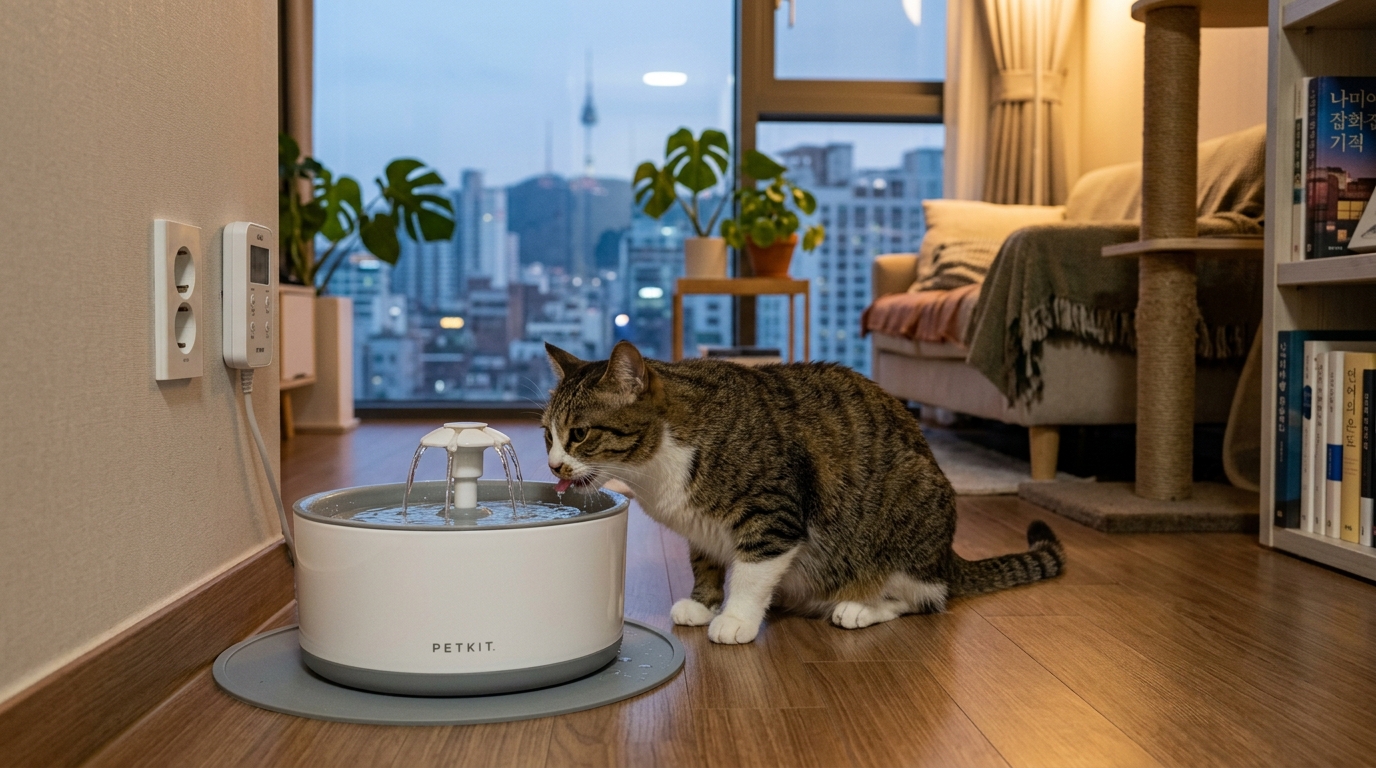
Does Every Cat Need a Water Fountain?
No.
Some cats drink more readily from moving water.
Others prefer a quiet, still bowl.
A fountain is one option, not a requirement.
If you buy one and your cat ignores it, that does not mean you failed.
Leave a regular bowl available and let the cat choose.
If you do use a fountain, cleanliness matters.
The pump, reservoir, filter area, and surfaces need regular maintenance.
Should I Leave a Faucet Dripping All Day?
There is usually no need.
Some cats enjoy running water, but leaving a bathroom or sink tap dripping continuously is not necessary for good hydration.
Bathrooms may also contain soap or cleaning residues, and sink water is harder to manage as a consistently clean drinking station.
If your cat prefers moving water, a clean pet fountain is a more controllable option.
And remember: not every cat prefers moving water.

Wet Food Can Increase Water Intake, but It Is Not Mandatory for Every Cat
Wet food is a practical way to increase dietary moisture.
That makes it useful for many cats.
But it does not mean every healthy cat must eat wet food or that dry food automatically causes dehydration.
The whole diet matters.
So do body condition, calorie intake, medical history, and individual preference.
Cats with diagnosed kidney disease, urinary stones, or other medical conditions may have specific dietary plans, so major changes should be discussed with the veterinarian managing that condition.
If Adding Water to Wet Food Helps, Is More Always Better?
No.
Some cats happily eat food with a little extra water mixed in.
Others reject it when the texture changes too much.
If you turn a familiar meal into a soup and the cat stops eating, you have not improved the situation.
Increasing moisture should not come at the cost of substantially reducing food intake.
Change texture gradually and watch what the individual cat accepts.
Can I Syringe Water Into My Cat’s Mouth?
Not simply because your cat seems to drink less than expected.
Forcing water into the mouth can create problems if the cat resists or cannot swallow normally, including aspiration risk.
If a sick cat is weak, not eating, and not drinking, the priority is to find out why.
If fluid therapy is needed, the veterinarian can decide the appropriate route and amount based on the cat’s condition.
Now We Need to Switch to a Completely Different Topic: Toxic Exposure
Everyday hydration and poisoning are not the same problem.
A cat does not become vulnerable to lily poisoning simply because the water bowl was less used that day.
True lilies are dangerous because the plant itself is toxic to cats.
And dehydration does not make every food or household substance suddenly become a direct kidney toxin.
Toxicology has to be considered substance by substance and species by species.
Why Are Lilies So Important in Cats?
If you live with a cat, this is one toxin worth remembering.
True lilies in the genus Lilium and daylilies in the genus Hemerocallis can cause severe acute kidney injury in cats.
The danger is not limited to a cat chewing up an entire flower.
FDA warns that exposure can occur through the leaves, flowers, stems, pollen, or even the water in a vase containing these plants.
Pollen on the coat is particularly concerning because the cat may ingest it during grooming.
And this is important:
A well-hydrated cat is not protected from lily toxicity.
Lily exposure is an emergency independent of normal water intake.
Not Every Plant With “Lily” in the Name Causes the Same Kidney Toxicity
Common plant names can be confusing.
FDA distinguishes true lilies and daylilies from other plants that have “lily” in their common names but do not produce the same acute kidney injury syndrome.
For example, peace lilies belong to a different plant group and cause a different type of toxicity.
That does not mean you need to become a botanist.
If your cat was exposed to a plant you cannot confidently identify, take a photo and contact a veterinarian or poison-information service.
If Lily Pollen May Be on the Coat, Do Not Wait for Symptoms
A very common thought is:
“I never saw my cat eat the flower.”
But that does not fully rule out dangerous exposure.
If pollen lands on the coat, the cat may swallow it while grooming.
Vase water can also be a route of exposure.
If your cat was near true lilies and you notice pollen on the fur, chewed plant material, missing petals, or possible access to vase water, contact a veterinarian immediately.
Do not wait for vomiting or lethargy to appear before asking for help.

Should I Make My Cat Vomit at Home After Lily Exposure?
No.
Do not use hydrogen peroxide or salt to induce vomiting in a cat.
Hydrogen peroxide can cause serious gastrointestinal injury in cats and is not recommended as a home emetic.
Salt can cause its own toxicity.
If lily exposure is possible, call a veterinarian or emergency clinic instead of experimenting with home remedies.
The veterinary team will decide what treatment is appropriate based on the exposure and timing.
Do Grapes and Raisins Destroy a Cat’s Kidneys the Same Way They Do in Dogs?
This is where species differences matter.
Grape- and raisin-associated acute kidney injury is well established in dogs.
Tartaric acid has received considerable attention as an important toxic component.
But the evidence in cats is far more limited.
Merck Veterinary Manual notes that grape- or raisin-associated kidney failure has been reported extensively in dogs, while only a single feline case has been reported.
VCA similarly notes that it is unclear whether cats have the same susceptibility.
So avoid both extremes.
Do not say:
“Grapes are proven to be just as nephrotoxic in cats as in dogs.”
But also do not say:
“Cats are safe because the evidence is limited.”
Limited evidence is not the same as proven safety.
What If My Cat Ate a Grape or Raisin?
Do not intentionally feed grapes or raisins to cats.
If you know or suspect your cat swallowed some, contact a veterinarian and provide as much information as you can: what was eaten, approximately how much, and when.
Do not attempt home vomiting induction.
The important distinction is about certainty of evidence, not about encouraging exposure.
Lilies are a well-established feline kidney toxin.
Grape and raisin toxicity in cats is much less clearly established.
Salt Is Not Simply a “Kidney-Destroying Poison” Either
Large salt exposure can certainly be dangerous.
But the main toxic problem is not best described as direct destruction of kidney cells.
Excessive sodium exposure can produce hypernatremia and neurologic disease, particularly when water access is limited or fluid balance becomes severely disturbed.
Clinical signs can include gastrointestinal problems, weakness, abnormal gait, tremors, seizures, and other neurologic abnormalities.
That is a different toxic mechanism from lily-associated acute kidney injury.
If My Cat Ate a Lot of Salt, Should I Force Huge Amounts of Water?
No.
Severe hypernatremia requires controlled medical correction.
Changing sodium concentration too rapidly can itself be dangerous.
If significant salt exposure is suspected, especially with vomiting, extreme thirst, abnormal gait, tremors, or neurologic signs, contact a veterinarian.
Do not try to correct the problem by force-feeding large amounts of water at home.
What About Antifreeze? Is It Dangerous Only When a Cat Is Dehydrated?
No.
Ethylene glycol-containing antifreeze is toxic because of the chemical itself.
A cat does not need to be dehydrated first.
This is another reason not to group toxins together under a vague idea such as:
“Anything nephrotoxic destroys a dehydrated kidney.”
Toxic effects depend on the specific substance, the animal species, the amount, and the timing of exposure.
The Easiest Way to Avoid Confusion Is to Separate Daily Hydration From Poisoning
Daily hydration is an everyday management issue.
You make fresh water easy to access.
You offer different bowl locations.
You consider dietary moisture.
You watch your cat’s preferences and normal patterns.
Toxic exposure is different.
If a dangerous substance may have been ingested or contacted, the risk is judged by the toxin itself.
That leads to two very different responses:
Less visible drinking → assess diet, routine, urine, and health changes.
Possible true lily exposure → call a veterinarian immediately.

Frequently Asked Questions About Cat Hydration and Dehydration
My cat barely drinks from the water bowl. Is that normal?
It can be, especially if your cat eats a moisture-rich diet.
Water from food counts toward total intake.
What matters more is whether this is your cat’s normal pattern and whether appetite, urine output, and activity remain normal.
Does eating only dry food mean my cat is chronically dehydrated?
Not automatically.
Dry food contains less moisture, so drinking water becomes more important, but diet type alone does not diagnose dehydration.
My cat suddenly drinks a lot more water. Is that good?
A sudden increase in thirst can be a sign of disease.
If urine volume has also increased, conditions such as kidney disease, diabetes mellitus, or hyperthyroidism may need to be investigated.
Do not restrict water.
Exactly how much water should my cat drink every day?
Total water needs vary with body size, diet moisture, health status, environment, and individual physiology.
A single household target is not appropriate for every cat, especially cats with medical conditions.
A meaningful change from your cat’s usual intake is often more useful than chasing one universal number.
If my cat eats wet food, do I still need a fountain?
A fountain is optional.
Wet food increases dietary moisture, while bowls or fountains provide free-choice drinking water.
Use whatever combination your cat actually accepts.
Do cats always prefer running water?
No.
Some do.
Some prefer still water.
Individual preference matters.
Do food and water bowls have to be far apart?
There is no single required distance.
Offer water in more than one reasonable location and see what your cat actually uses.
My cat only sniffed the lily. Is that an emergency?
Simply being near a flower is not the same as known ingestion.
But if pollen may have contacted the coat, the plant has been chewed, or the cat may have licked the flower or drunk vase water, contact a veterinarian immediately.
I think my cat licked lily pollen
Do not wait for symptoms.
Pollen exposure from true lilies or daylilies can be medically significant in cats.
My cat ate one grape. Is that the same emergency as lily exposure?
The evidence is different.
Grape and raisin kidney toxicity is well established in dogs but poorly documented in cats.
That does not prove safety, so contact a veterinarian for advice, but it should not be presented as the same well-established feline nephrotoxic risk as true lilies.
Can I make my cat vomit at home if poisoning is suspected?
No.
Do not use hydrogen peroxide or salt as home emetics for cats.
Call a veterinarian and explain what substance was involved and when the exposure may have occurred.
Drinking Less Water and Eating a Poison Are Not the Same Problem
Some days you look at the water bowl and think:
“Why has hardly any water disappeared?”
That is when you look at the rest of the picture.
Did your cat eat wet food?
Is urine output normal?
Are appetite and activity normal?
Has anything actually changed?
Another day, the situation may be completely different.
There is a bouquet on the table.
True lily pollen has fallen nearby.
Your cat has been walking through the area.
At that moment, this is no longer a hydration question.
A cat does not become safe from lily toxicity because they drank well that morning.
Likewise, grapes and raisins should not be placed in exactly the same feline evidence category as true lilies.
And salt toxicosis should not be described as a simple direct kidney poison made worse by dehydration.
Different substances cause harm in different ways.
Different species have different levels of evidence.
Ansim wants you to remember two separate rules:
For everyday hydration, increase safe choices and watch your cat’s normal pattern.
For toxin exposure, identify the substance accurately and do not delay when the toxin is an established feline emergency.
Keeping those two ideas separate helps prevent unnecessary panic over a quiet water bowl while also making it much harder to miss a genuinely dangerous lily exposure.
Ansim’s Research Note
When a cat seems to drink very little, owners naturally stare at the water bowl.
Ansim looks at the food bowl and litter box too.
Is the cat eating wet food?
Has urine output changed?
Did appetite or activity suddenly drop?
Has the cat actually changed, or has the bowl always looked like this?
When I want a cat to take in more water, I do not start with one mandatory product.
Some cats prefer a regular bowl.
Some like a fountain.
Some take in more water comfortably through food.
The goal is to create options.
But when true lilies enter the story, the rule changes completely.
A well-hydrated cat can still be poisoned by lilies.
And I would not describe grapes or raisins with the same level of certainty in cats when the strongest evidence is in dogs.
Hydration is an everyday management question. Toxic exposure is a substance- and species-specific medical question.
Keeping those two questions separate is the most important lesson in this article.
Leave a Reply