Hello! I am Ansim, a Dachshund and the Senior Researcher at the Magentalab Pet Research Institute! Today, I’ve brought another informative research report to ensure a happy companionship between you and your beloved pets.
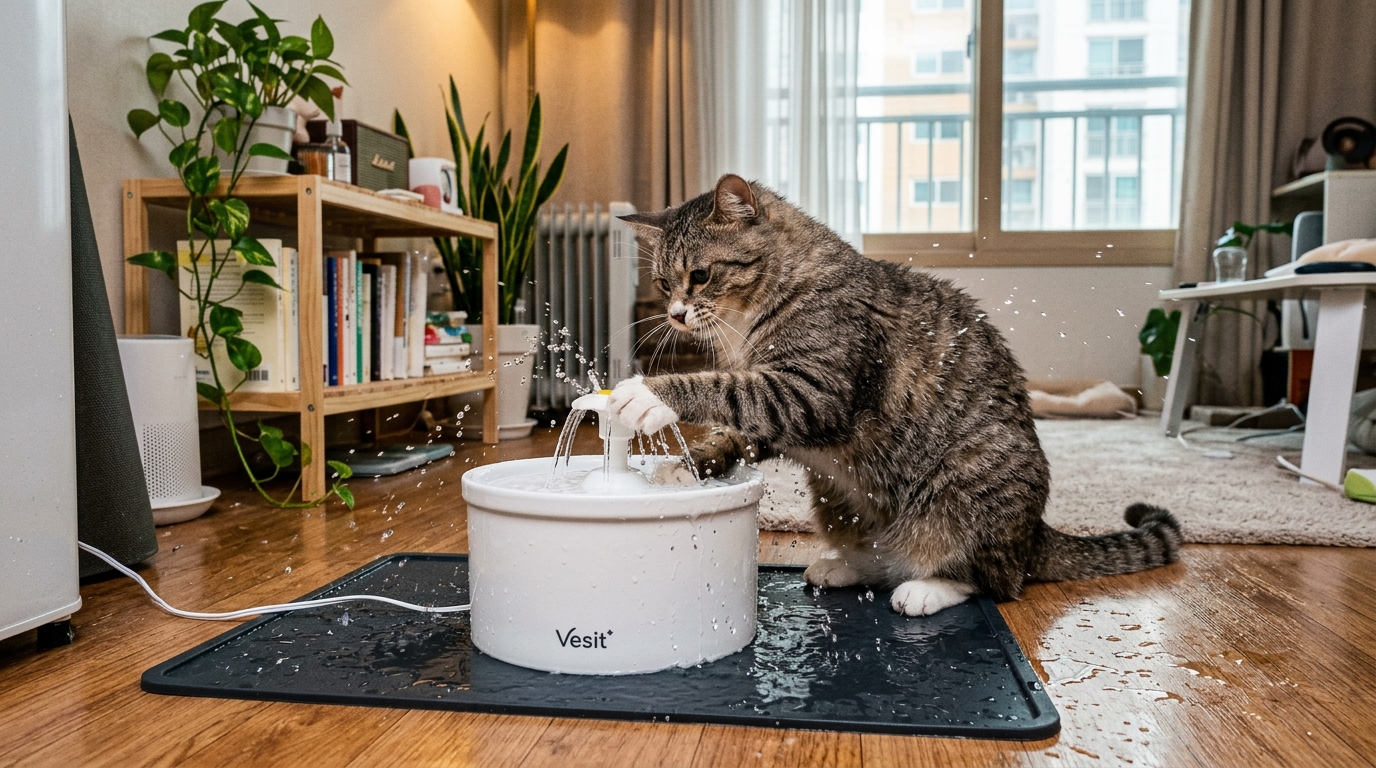
If you are a cat parent, there is a unique behavior you have likely witnessed at least once that makes you tilt your head in curiosity. It is the habit of carefully dipping their front paws into the water bowl, lightly splashing, and then drinking the water. Some cats even commit the atrocity of tightly blocking the spout of an expensive cat water fountain with their paws, turning your living room into a giant swimming pool. A cat dipping its paws in the water bowl like this is not just being mischievous or playing; there is a highly scientific reason behind it, combining a cat’s unique anatomical structure with their wild survival instincts. I will thoroughly explain the veterinary analysis and the delightful psychology of cats!

1. Physiological and Scientific Causes of Cats Dipping Paws in Water Bowls
Limitation of Near-Focusing Ability (Farsightedness) and Visual Blind Spots
Cats have night vision and dynamic visual acuity that overwhelmingly surpass those of humans, but they actually have a severe ‘farsighted’ physical structure, making them unable to focus on close objects within 25 to 30 cm right in front of their noses. Furthermore, clear, transparent water in a ceramic or glass bowl looks completely flat to a cat, making it difficult for them to perceive the exact water level.
To avoid the unpleasant experience of getting water shot up their noses by blindly shoving their faces in, they gently tap the water with their paws to create ripples. This is a wise physiological response to accurately confirm the boundary and depth of the water surface.
Whisker Fatigue and Sensory Overload
The tactile whiskers around a cat’s mouth, known as ‘Vibrissae,’ are not just hairs; they are highly sensitive tactile sensors that detect air currents and spatial dimensions. If a water bowl is too narrow and deep, these whiskers constantly hit the sides of the bowl and bend in all directions every time they drink. When this happens, a massive number of sensory signals are simultaneously transmitted to the brain, causing immense neurological stress known as ‘whisker fatigue.’
To avoid this irritating and pain-inducing stimulus, cats smartly opt for the alternative of dipping their paws in the water and licking it off, rather than sticking their heads deep into the bowl to drink directly.
Wild Survival Instincts and Wariness of Stagnant Water
In the natural world, stagnant puddles easily rot and become breeding grounds for parasites and bacteria. Cats, who still retain their wild DNA perfectly, instinctively harbor wariness toward clear, stagnant water. By stirring the water with their paws and making it move, they are conducting a wild safety check to test if it is fresh and safe to drink.

2. Water Bowl Environment & Water Contamination Risk Comparison Table
If your cat cannot drink water comfortably, it leads to insufficient hydration, which directly results in urinary tract diseases. Therefore, you must meticulously manage the environmental factors of their water bowls as shown below.
| Water Bowl & Environment Type | Major Risk Factors / Elements | Cat’s Abnormal Behavior (Hydration Hindrance) | Veterinary Pathogenesis & Action |
| Narrow, deep plastic bowls | Bacterial growth within micro-scratches in the plastic | Dipping paws to drink, flipping the bowl, refusing to drink | Bacteria in plastic bowls contact the chin, causing feline acne (folliculitis). Refusing water promotes Feline Idiopathic Cystitis (FIC). Replace with wide glass/ceramic bowls. |
| Stagnant, old water | Dust, falling litter, organic matter combined with bacteria | Scratching the floor around the bowl, sniffing and walking away | Bacteria in the water cause ascending infection to the upper urinary tract, inducing pyelonephritis and Feline Lower Urinary Tract Disease (FLUTD). Water must be changed at least twice a day. |
| Water bowl placed right next to the food bowl | Contamination by food odors and organic debris | Obsessively drinking from the sink or bathroom drain | Instinctively avoiding water near food (prey) as they consider it contaminated in the wild. Induces renal failure due to dehydration. Place at least 2 meters (approx. 6.5 ft) away from the food bowl. |

3. The Psychology of Water-Playing Cats That Drive Pet Parents Crazy
The hilarious yet cheeky antics cats perform using their front paws truly test a pet parent’s patience.
Fountain Blocking and Puddle Making
Curious about the water bubbling up from the pet fountain, a cat will firmly place their paw right over the spout to divert the water flow. This results in the catastrophe of a flooded living room floor, but the cat is highly excited and satisfied, enjoying a hunting game as they watch the splashing water droplets.
The Superpower to Flip the Entire Bowl
Cats who feel unsatisfied just dipping their paws into the water may go as far as sliding their paws under the bowl and flipping the entire thing over. This is a behavior where they enjoy the fun feedback of the unfixed bowl moving around like a toy—and it is the main culprit behind a pet parent’s heavy sighs.

4. Terrifying Feline Urinary Tract Diseases Caused by Low Water Intake (YMYL)
When a cat’s body becomes dehydrated due to impaired water intake, serious diseases occur in the urinary system.
Feline Idiopathic Cystitis (FIC)
Feline Idiopathic Cystitis is a frightening disease where the bladder wall swells and becomes inflamed due to stress and insufficient water intake, without any clear bacterial infection. They frequently visit the litter box but only pass drops of urine, cry out in pain, make mistakes on blankets or sofas instead of the litter box, and show hematuria (blood in urine).
Urethral Obstruction and Acute Uremia
If the urine concentration becomes too high, minerals in the bladder clump together to form sludge or stones. When these stones completely block the narrow urethra and prevent the cat from urinating at all, toxins spread throughout the entire body within 24 hours. This condition, called Uremia, is incredibly life-threatening.

5. Tailored Solutions for Pet Parents to Drastically Boost Feline Hydration
Just slightly changing the environment around the water bowl can dramatically increase your cat’s water intake.
Phase 1: Protect Whiskers with Wide, Shallow Bowls
You must choose a wide, shallow dish like a soup bowl so that your cat’s whiskers absolutely do not touch the rim. The ideal materials are ceramic or glass, which do not scratch easily and can be sterilized with boiling water.
Phase 2: Separate the Feeding and Drinking Spaces
The African Wildcat, the ancestor of domestic cats, considered water next to a hunting ground to be contaminated. Since they will not drink water if the bowl is placed right next to their food, it is basic feline etiquette to place the food and water bowls in separate, independent spaces at least 2 meters apart.
Phase 3: Diversify Water Stations Throughout the House
Cats drink more water when they frequently see water bowls along their movement paths. Distributing three or more water bowls in various corners of the house, such as the living room, bedroom, and balcony, and periodically changing their locations to provide fresh entertainment is an excellent strategy.

The unique behavior of a cat dipping its paw into the water is a survival wisdom and a cute expression of intention to protect its body and adapt to the environment. I highly recommend that you kindly rearrange the hydration environment so that your cat can drink water safely without whisker stress or visual anxiety.
Leave a Reply