Hello! I am Dachshund Ansim-i, the lead researcher at the MagantaLab Pet Research Institute! Today, I have brought another informative research report to ensure a happy journey between you and your furry friends.
When pet parents leave for work, do the 10 hours a dog spends alone pass exactly the same as human hours? Surprisingly, according to veterinary perspectives and animal behavior research, time flows much slower for our pets. The 10 minutes we might easily spend scrolling on a smartphone can feel like days to them when left alone at home. I will clearly analyze the secret of why time flows so differently even when we share the exact same living room.
| Classification | Human Time Perception | Pet Time Perception |
| Standard | Clocks, numbers, visual information | Olfactory cues, biological rhythms, color/temperature of light |
| Perceived Speed | Matches the objective flow of time | Experienced slower than humans depending on metabolic rate |
| Memory Method | Episodic-centered (past-future deduction) | Association-centered (current smells and situations) |
| Stress | Manageable by recognizing time | Psychological pressure of waiting indefinitely |
1. Experiencing Dog Time Perception: The Principle of the Olfactory Clock
Pets cannot read the clock on the wall. Instead, their sensitive noses act as the ticking hands of a clock. In behavioral science, this is called the “Olfactory Clock.” When pet parents leave the house in the morning for work, a strong scent remains indoors. As time passes, the scent particles in the air gradually settle, and the concentration weakens.

Dogs analyze this difference in fading scent concentration and determine, “Ah, it has been quite a long time since my pet parent left.” As your typical return time approaches, they remember the pattern of you opening the door when the scent level in the house drops below a certain threshold. Therefore, a dog with a pet parent who returns at a consistent time every day can wait by the door, wagging its tail with uncanny accuracy. This is not because the animal looked at a clock, but the result of perfectly mastering the evaporation cycle of scents.
The Secret of Metabolic Rate and the Perceived Time Dogs Feel When Pet Parents Are Out
Small animals with fast heart rates and active metabolisms perceive the world almost in slow motion. It is the same reason a fly easily dodges a human’s flyswatter. For dogs and cats, whose average heart rates are faster than humans, a 24-hour day is highly likely to be perceived visually and sensorily as much longer than what humans feel.

The 8 hours pet parents leave a dog behind in an empty house is a cruelly long time for them. The process of staring intently at the front door, waiting for their owner’s scent to completely disappear, is accompanied by immense psychological pressure. Research showing that a dog left alone for 1 hour and a dog left alone for 8 hours display different intensities of joy when their owner returns proves that they, too, clearly feel the physical length of time.
2. The Correlation Between Dog Separation Anxiety Symptoms and Cat Biological Rhythms
This difference in perceived time often leads to a severe behavioral issue: separation anxiety. This happens because they feel like time stretches endlessly in situations where they cannot predict when their pet parent will return. Pets who experience irregular routines or have not learned the scent change patterns feel extreme fear. Please consult a veterinarian for an accurate diagnosis of underlying diseases or abnormal behaviors. In severe cases of separation anxiety, beyond simply waiting, they may show destructive abnormal symptoms such as chewing on walls, howling, or having potty accidents despite normally being well house-trained.

Cats are no different. Cats are strictly creatures of routine and territory. They accurately gauge meal and hunting times not only through their sense of smell but also by the angle of light coming through the window, the length of shadows, and the biological rhythm of stomach hunger that comes at regular intervals. If their regular mealtime is delayed by just 1 hour, the reason your cat nervously vocalizes or nudges you is that their internal clock is ringing an alarm.
Indoor Environment Setup Tips to Reduce Perceived Time for Home-Alone Pets
Then, what are the methods to make the flow of time faster and less boring for pets left alone? The key is to distract their senses of sight, hearing, and smell.
The most intuitive method is to leave several worn clothes or towels carrying a strong scent of the pet parent around the pet’s bed. This effectively disrupts their olfactory clock by delaying the dispersion of your scent.

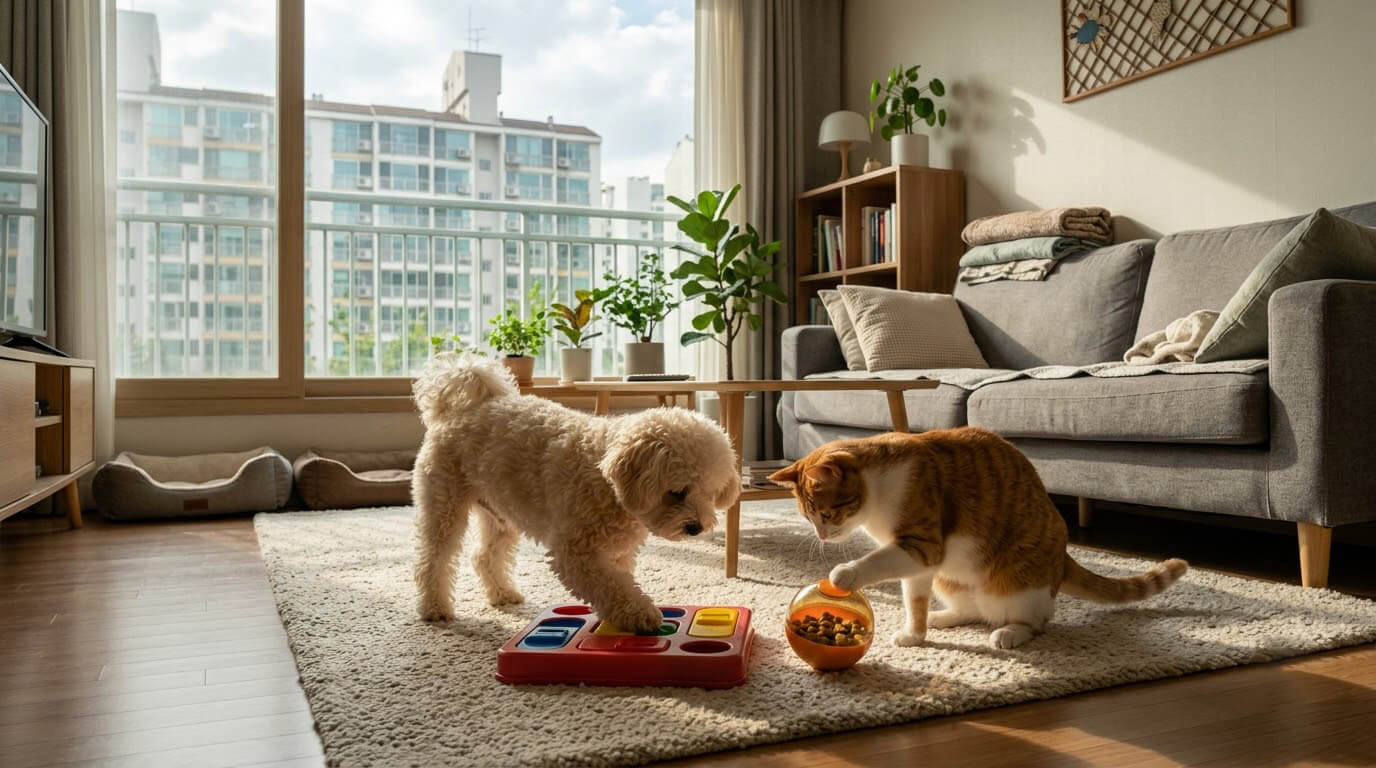
Also, an active walk of 15 minutes or more before leaving is essential. If you tire out their brain by letting them sniff various scents outside, the time they spend sleeping when left alone at home will increase. While sleeping, they feel the passage of time far less. In addition, place nosework toys hiding their favorite treats throughout the house. While they use their brains and focus on finding their targets, their perceived time will fly by. It is also an excellent strategy to block their sense of hearing by quietly playing external white noise or classical music so they do not react sensitively to footsteps heard from outside.
3. Utilizing App Booking Systems and Pet Care Strategies for Modern Pet Parents
Modern pet parents living busy lives cannot perfectly stay by their pets’ sides all the time. Long work hours are a given, and sometimes sudden business trips or travels occur. In times like these, you must utilize technology and platforms to fill your pet’s empty time.

Recently, various reliable pet care booking platforms operating in stable and fast web environments have emerged. Actively utilize systems that allow you to log in anytime, anywhere via your smartphone to book a pet sitter’s visit or call a professional dog walker. Even if a friendly (or even unfamiliar) visitor comes in the middle of the day to interact and play with them for just 1 hour, your pet’s perceived daily time is completely reset. You can experience the miracle of a boring 10-hour stretch being divided into two vibrant 5-hour periods.
Furthermore, integrating IoT technology like smart automatic feeders or home cameras to dispense treats at regular intervals is highly helpful in stabilizing their biological rhythms. Periodically monitoring your pets’ status through a mobile app and immediately booking external services whenever necessary to meticulously plan your pets’ daily schedules is exactly the attitude of a responsible pet parent.

Leave a Reply